Growing bodies place new demands on teenagers, from competitive sport and dance to long hours at a desk or on a screen. With over 25 years of clinical experience, we help young people move well, recover from injury and stay active through the changes of adolescence.
Between 13 and 18, rapid growth changes height, strength, flexibility and coordination, all while placing new demands on the body. The aim isn't just to treat pain, but to help young people move well, stay active and build healthy habits for the future.
From sudden sports injuries to growth-related aches, here's what we see most often in teenagers and young adults.
Sports Injuries
The most common problem in active teenagers, from a sudden knock to a niggle that's built up gradually through training.
Muscle strains+
Occur when a muscle is stretched or torn beyond its capacity, often during sudden or intense movement.
Ligament sprains+
Common in the ankle and knee, often following a fall or a sudden change of direction.
Knee & ankle injuries+
Frequent in running, jumping and contact sports, ranging from mild sprains to more significant injury.
Falls & collisions+
Can cause anything from bruising to more significant muscle, ligament or joint damage.
Growth-Related Problems
During growth spurts, bones can grow faster than muscles and tendons can adapt, leading to tightness, altered coordination and discomfort.
Growth spurts & flexibility changes+
Rapid growth can bring muscle tightness, changes in flexibility and temporary aches, especially in running and jumping sports.
Osgood-Schlatter Disease+
Pain and tenderness at the front of the knee during periods of rapid growth, particularly in active teenagers.
Sever's Disease+
Heel pain in growing children and teenagers, especially those involved in running and jumping activities.
Back, Neck & Headaches
Long periods studying, sitting and on phones or laptops can contribute to discomfort and tension.
Back & neck problems+
Symptoms can also develop after exercise, lifting, sport or an awkward movement.
Headaches & muscular tension+
Some teenagers experience headaches alongside neck stiffness or postural tension. Persistent or severe headaches should always be medically assessed.
Postural & screen-related discomfort+
The aim isn't a rigid "perfect posture", it's comfortable movement and regular changes of position.
Overuse, Tendon & Muscle Injuries
Increasing training too quickly or repetitive movement without enough recovery can overload muscles and tendons.
Overuse & repetitive strain+
Particularly common in running, gymnastics, dance, swimming, throwing sports and intensive training programmes.
Tendon problems+
Develop when the demands on a tendon repeatedly exceed its ability to adapt, common with running, jumping and gym training.
Muscle strains & ligament sprains+
Can happen during sport, exercise or everyday activity, or following a fall or sudden change of movement.
Hypermobility & Spinal Conditions
Some teenagers naturally have greater joint flexibility or spinal changes that become more noticeable during growth.
Joint hypermobility+
Doesn't necessarily cause problems, but some teenagers experience joint discomfort, fatigue, instability or recurrent sprains.
Scoliosis & spinal problems+
Where necessary, physiotherapy forms part of a wider medical or specialist management programme.
Dance, Gymnastics & Music
Young performers place considerable demands on their muscles, joints and connective tissues through repetitive training.
Dance, gymnastics & performing arts+
Treatment and rehab tailored to the specific demands of the individual's activity and performance schedule.
Young musicians+
Prolonged practice and sustained postures can place stress on the neck, shoulders, back, arms, wrists and hands.
Inflammatory & Rheumatological Conditions
Not all musculoskeletal symptoms come from sport or posture, some teenagers develop inflammatory conditions affecting joints, muscles, tendons and spine.
Juvenile idiopathic arthritis+
And other inflammatory conditions that can affect a teenager's joints, muscles, tendons and spine.
Multidisciplinary care+
Physiotherapy forms an important part of wider care, alongside appropriate medical and rheumatological management.
Rehabilitation After Injury or Surgery
Following a fracture, dislocation, significant sporting injury or orthopaedic surgery, rehab restores movement, strength, balance and confidence.
Post-fracture & post-surgical recovery+
Structured rehabilitation to rebuild movement, strength, balance and coordination step by step.
Return to school & sport+
A gradual, confidence-led return to normal activities, school and sport, built around the individual.
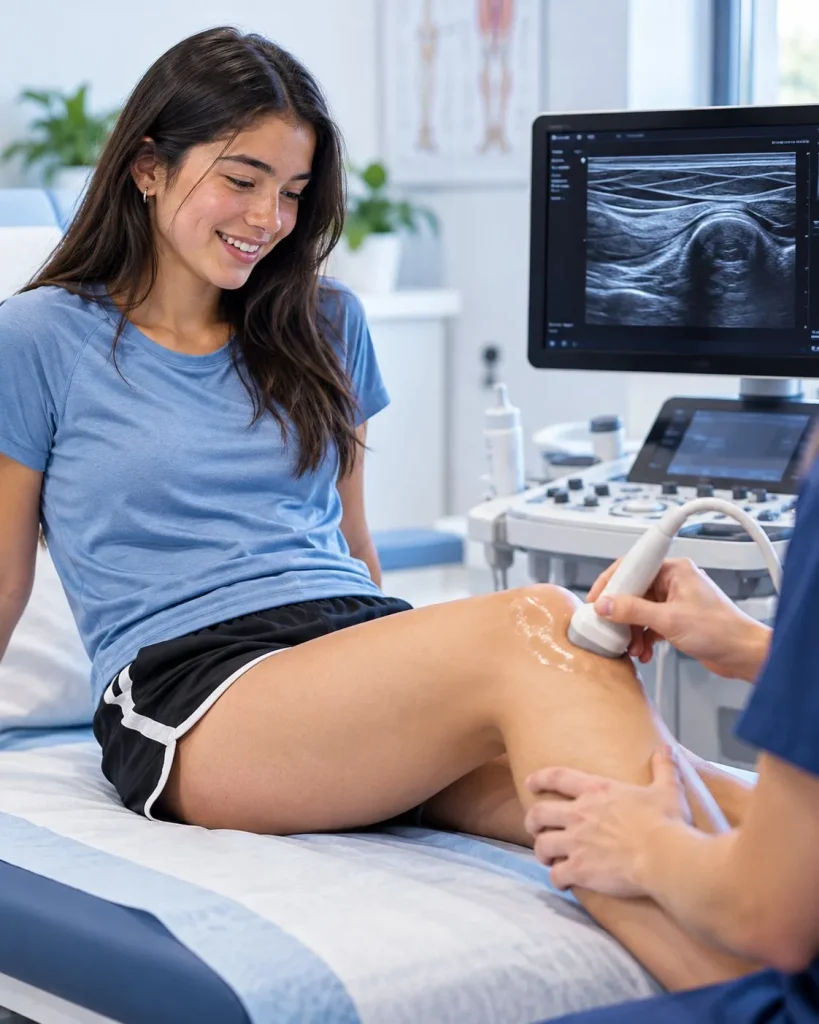
Point-of-Care Ultrasound Scan for Faster Answers
Getting an accurate diagnosis is often the first step to effective treatment, especially when symptoms are unclear or slow to resolve. MSK ultrasound is safe, radiation-free and shows muscles, tendons, ligaments and joints in real time, including while moving.
Same-appointment scanningFindings are related directly to your teenager's symptoms and movement during the same visit.
Safe & radiation-freeWell tolerated by teenagers, with no radiation exposure.
Tracks healing over timeUseful for tendon and ligament injuries, muscle tears, joint swelling and monitoring recovery.
Help Your Teenager Move Well, Recover Well and Stay Active
Treatment is tailored to the individual teenager, their condition, lifestyle and goals, with an emphasis on progressive treatment rather than simply resting until symptoms disappear.
Hands-On Care
Manual & hands-on therapy
Soft-tissue techniques
Stretching & mobility work
Build & Progress
Strength & conditioning
Core & postural exercises
Balance & coordination
Progressive loading
Getting Back to Life
Sport-specific rehabilitation
Ergonomic & lifestyle advice
Safe return to sport
Injury prevention education
Why Parents Choose Physivity
Practical support to help young people move comfortably and stay active in the things they enjoy.
25+ Years of Experience
Individualised treatment for a wide range of musculoskeletal problems affecting teenagers and adolescents.
Age-Appropriate Care
Treatment accounts for your teenager's stage of growth and development, not just a generic adult plan.
Sport & Performance-Specific
Rehab tailored to the demands of your teenager's sport, dance, gymnastics or instrument.
Diagnosis & Treatment Together
Ultrasound diagnostics and physiotherapy under one roof, in the same clinic.
 The Landsby, Merrion Ave, Stanmore. HA7 4RY
  Monday–Friday, 3:00 pm–8:00 pm; Saturday, 8:00 am–1:00 pm
  02038118464
  info@physivity.co.uk
 02038118464
  info@physivity.co.uk